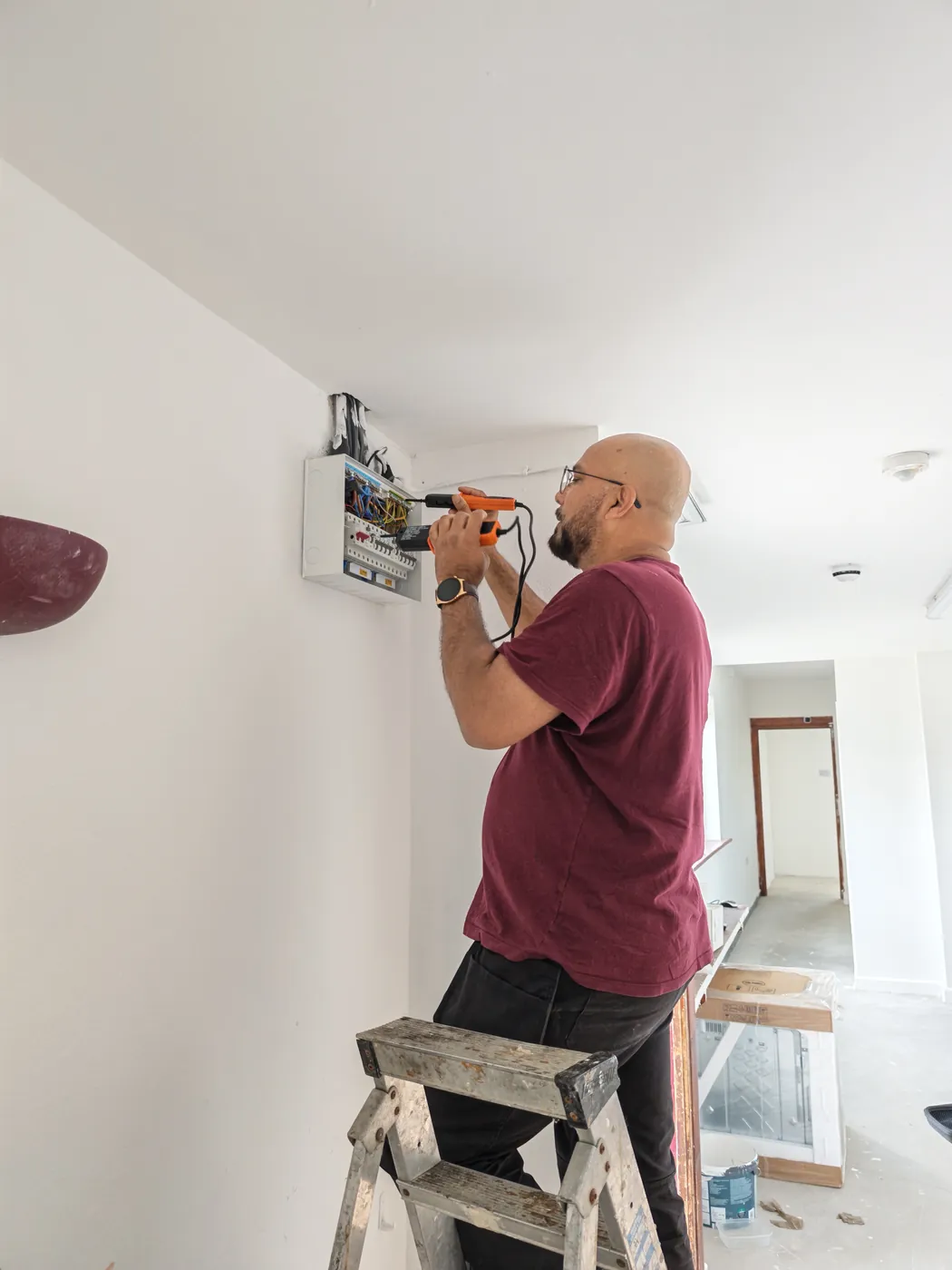
An EICR (Electrical Installation Condition Report) is a formal inspection and test of the fixed wiring in a building: the consumer unit, every circuit, the sockets, switches, light fittings, and the earthing and bonding that make a fault safe. It is not a pass certificate. It's a report on the installation's condition on the day, measured against the current wiring regulations, BS 7671:2018+A4:2026.
Homeowners usually book one when they buy a house, before a renovation, or when the wiring is old and they want to know where they stand. Landlords need one by law, and businesses need one to show the installation is maintained. Whoever you are, you should come away knowing what is safe, what isn't, and what it will cost to put right.
What we inspect and test
We start with a visual inspection, because that is where most problems show up: scorched accessories, missing blanks in the consumer unit, cables without proper protection, bonding clamps that have been painted over or disconnected. Then we test each circuit with calibrated instruments:
- Continuity of protective conductors (R1+R2), which proves the earth path reaches every point;
- Ring final circuit continuity, which finds broken or interconnected rings that can overload a cable;
- Insulation resistance, which shows whether the cable insulation is breaking down. BS 7671 sets a minimum of 1 MΩ, and healthy circuits usually read well over 100 MΩ;
- Polarity, which checks that switches and fuses are in the live conductor, not the neutral;
- Earth fault loop impedance (Zs), which tells us whether a fault would trip the breaker fast enough;
- RCD operation, which checks that each RCD trips at its rated current and within the required time. A 30 mA device usually trips in 15–40 ms; anything near the 300 ms limit needs attention.
Every result goes into the schedule of test results, so a future electrician can compare figures and spot deterioration.
How faults are coded
Each problem we record gets one of four codes. The codes, not the length of the list, decide whether the report is satisfactory:
| Code | Meaning | What happens next |
|---|
| C1 | Danger present, risk of injury | Made safe before we leave, usually by isolating the circuit |
| C2 | Potentially dangerous | Urgent repair. The report is unsatisfactory until it's fixed |
| FI | Further investigation required without delay | Something we couldn't confirm in the time or access available |
| C3 | Improvement recommended | Not a fail. Worth planning for, especially when you next do work |
A report with only C3 observations is still Satisfactory. A common example is a distribution board mounted too high to reach comfortably: worth noting, not dangerous. One C1, C2 or FI makes the whole report Unsatisfactory. We code to the guidance in Electrical Safety First's Best Practice Guide 4 rather than to our own preferences, and we explain every code in plain English. You can read more in our guide to EICR codes C1, C2, C3 and FI.
How long it takes
A one or two-bedroom flat normally takes two to three hours. A three-bedroom house takes around three to four, and larger houses or properties with several boards take longer. The power has to go off circuit by circuit during testing, so plan around fridges, freezers, home-working and alarms. We'll tell you before each shutdown.
Time is mostly decided by the number of circuits and how easy they are to get at. Furniture against sockets, a boarded-over loft hatch or a locked meter cupboard all add time or create limitations on the report.
Read the limitations section
Every EICR has an Extent and limitations section, and it is the part most people skip. It says how much of the installation was actually inspected. Some reports test a sample, perhaps 25% of accessories, and exclude roof spaces, floor voids or anything above a certain height. That can be perfectly reasonable on a large commercial site, but a homeowner or landlord should know what was and wasn't looked at.
On homes we aim to inspect and test every circuit and a high proportion of accessories. If something can't be reached, we say exactly what and why, so the report means what it says.
How often you need one
The IET's recommended maximum intervals, which most insurers and lenders follow, are:
- Owner-occupied homes: every 10 years, and whenever the property changes hands;
- Rented homes and HMOs: at least every 5 years, a legal requirement in England (see our landlord certificate page);
- Offices, shops, restaurants and most commercial premises: every 5 years;
- Industrial units and places of entertainment: every 3 years.
The inspector can recommend a shorter interval if the installation is old or heavily used. That date goes on the report.
If the report is unsatisfactory
You'll get a written quote for the remedial work, itemised against the codes on the report, so you can see exactly what each repair addresses. You're free to use any qualified electrician for the repairs. If we do the work, we issue the right certificates afterwards, so you have the paper trail that landlords and insurers ask for. Our guide on what to do when an EICR fails covers this in more detail.